lunes, 25 de marzo de 2013

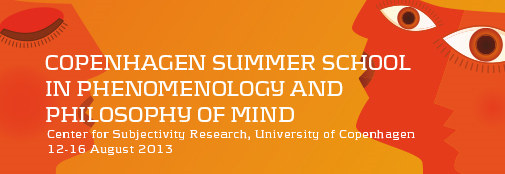
Copenhagen Summer School in Phenomenology and Philosophy of Mind 2013


Evento: Escuela de verano sobre fenomenología y filosofía de la mente en Copenhague
Tema: La filosofía de la mente para la fenomenología
Fechas: 12 al 16 de agosto de 2013
Lugar: Universidad de Copenhague, Dinamarca
Idiomas: Inglés
Deadline: Envío de sumillas hasta el 10 de mayo de 2013


The course will provide essential insights into central themes within the philosophy of mind, viewed from a phenomenological perspective.

Topics include:
Perception, Place, Normality, Embodiment, the Self, the You, and the We.
The course will consist of a mixture of key note lectures, PhD presentations and seminars (30 hours total), aimed at advanced MA students and PhD students. Post Docs are also invited to apply. The Summer School is co-funded by the PhD programme in philosophy at the University of Copenhagen.

Speakers:
Steven Galt Crowell, Rice University
Sara Heinämaa, University of Helsinki
Rasmus Thybo Jensen, University of Copenhagen
Jeff Malpas, University of Tasmania
Søren Overgaard, University of Copenhagen
Dan Zahavi, University of Copenhagen

Programme: Click here for a preliminary programme.

Registration is now open: Please click here to register.

ECTS: Participation in the Summer School is expected to give 2 ECTS points, 3,5 if you give a talk.

Abstract submission:If you would like to give a talk at the Summer School you can submit an abstract. If you are elected, not only will you get to give a talk, you will also receive prepared feedback from the keynote speaker of the day you are speaking.

Deadline:The deadline is the same as the registration deadline: Friday 10 May.

How to submit an abstract (500-1000 words):
1. Send an email to s.overgaard@hum.ku.dk
2. Include the abstract as an attachment (acceptable formats: .doc, .docx, .rtf, and .pdf)
3. Ensure that the subject line of the email reads: Abstract Copenhagen Summer School 2012

martes, 19 de marzo de 2013

The 19th International Conference of the Friedrich Nietzsche Society


Título: The 19th International Conference of the Friedrich Nietzsche Society
Tema: "Thus Spoke Zarathustra: Gateway to the Oeuvre (and Opening to the East?)"
Fechas: 20 al 22 de septiembre de 2013
Organiza: Friedrich Nietzsche Society
Lugar: University College Cork, Ireland
Idiomas: Inglés
Deadline: Envío de sumillas hasta el 31 de marzo de 2013


Call For Papers
This will be the first conference of the Society to focus, in part, on a single work of Nietzsche’s: his own favourite, Also sprach Zarathustra. Given Nietzsche’s high opinion of this book (‘the profoundest book there is’), it’s surprising how many commentators prefer to avoid discussing it, usually on the grounds that it’s ‘too literary’ and ‘not philosophical’ enough. One question behind the choice of this work as a focus for the conference is thus: ‘How does Nietzsche’s philosophy look when it’s approached through this particular book?’ Preference will be given to papers that treat Zarathustra as a prism for Nietzsche’s other works.
 
As globalisation proceeds apace, Nietzsche scholarship in Asian countries continues to burgeon, and he becomes an ever more important reference point for those in the West who want to access Asian philosophies. A secondary theme (reflecting the interests of the UCC Philosophy Department) will be the relations of Nietzsche’s philosophy to Asian thought, as they emerge from Zarathustra and/or his other works. The purpose of the conference is thus twofold: to appraise Zarathustra as a centrally (if also eccentrically) philosophical work, and also to assess the value of comparative or intercultural approaches to Nietzsche’s philosophy from Asian perspectives.
 
The 2013 conference will follow the standard FNS conference format of five parallel sessions and five plenary sessions with well-known speakers in the field.

Plenary Speakers
  • Keith Ansell-Pearson (University of Warwick)
  • Bret Davis (Loyola University, Baltimore)
  • Volker Gerhardt (Humboldt Universität, Berlin)
  • Kathleen Higgins (University of Texas at Austin)
  • Paul Loeb (University of Puget Sound)
  • Graham Parkes (University College Cork)
  • (Davis and Parkes will do a joint session on Zarathustra and Zen Buddhist thought)

The Friedrich Nietzsche Society welcomes proposals for 30-minute papers on all topics bearing on the conference themes, including the following:
  • Zarathustra as an essentially philosophical work
  • Zarathustra as a gateway into Nietzsche’s entire oeuvre
  • Zarathustra: incipit tragoedia or incipit parodia?
  • The relation between the figure of Zarathustra and Nietzsche
  • Zarathustra: Dionysos or Kant?
  • The figure of woman in Zarathustra
  • Animality in Zarathustra
  • Metaphor and concept in Zarathustra
  • Nietzsche’s unique vocabulary in Zarathustra
  • The problem of communication in Zarathustra
  • Rhetoric and mythology in Zarathustra
  • The composition and structure of Zarathustra
  • Benefits of approaching Nietzsche (and Zarathustra) from an Asian perspective
  • Benefits of approaching Asian thought from a Nietzschean perspective
Papers on other key figures and/or themes in Zarathustra are also welcome. Preference will be given to papers that treat Zarathustra as a prism for Nietzsche’s other works.

Abstracts (max. 400 words) should be submitted by March 31 2013.
They should be sent as attachments to friedrich.nietzsche.society@gmail.com.

Please include the following information in the subject line: FNS2013_ABSTRACT_NAME_AFFILIATION

martes, 12 de marzo de 2013

Congreso Internacional "Nietzsche y Wagner: Perspectivas de la controversia"


Título: Nietzsche und Wagner. Perspektiven ihrer Auseinandersetzung
Tema: Relaciones entre Friedrich Nietzsche y Richard Wagner
Fechas: 17 al 20 de octubre de 2013
Organiza: Nietzsche-Gesellschaft
Lugar: Nietzsche-Dokumentationszentrum, Naumburg (Saale)
Idiomas: Alemán
Deadline: Envío de sumilla y CV hasta el 15 de mayo de 2013


Nietzsche und Wagner. Perspektiven ihrer Auseinandersetzung
Internationaler Kongress vom 17. bis 20. Oktober 2013 in Naumburg (Saale)

Die Begegnung zwischen Wagner und Nietzsche war von epochaler Bedeutung. Ihre Beziehung prägte ein Ringen um die Bewertung von Kultur und Kunst (in) der Moderne, hat die weltanschaulich-künstlerischen Kämpfe im 20. Jahrhundert nachhaltig beeinflusst und ist bis heute von ungebrochener Brisanz. Anlässlich von Wagners 200. Geburtstag widmet sich der Kongress der Vielfalt ihrer Standpunkte, die die Rezeption ebenso inspiriert wie provoziert haben. Zunächst gemeinsamen Idealen verpflichtet, kam es durch Nietzsches Abkehr von Schopenhauer und durch Wagners musikästhetische Entwicklung zu entschiedener Gegnerschaft. Neben Nietzsches massiver Bayreuthkritik gab es Differenzen über die Rolle des Chores in der griechischen Tragödie, das Verhältnis von Wortsprache zu Tonsprache, die Konzeption eines Gesamtkunstwerks sowie über den Begriff autonome Musik. Kulminationspunkt der Unversöhnlichkeit war der Parsifal: Wagners Kniefall vor dem Religiösen und seine Apotheose des Mitleids verfestigten die Gegensätze. Durch die Etablierung des Festspielbetriebes in Bayreuth hatte er sich von einem Kunstschaffen, das für eine in die Zukunft weisende Kultur stehen sollte, verabschiedet. Unstreitig ist dabei, dass Nietzsche den Komponisten und Musikdramatiker als einen Glücksfall seiner Kulturkritik der Moderne gesehen und inszeniert hat. Der Kongress widmet sich der Aktualität ihrer philosophisch-ästhetischen und kulturellen Debatten.

Wissenschaftliche. Leitung:
Jutta Georg (Frankfurt a. M.) und Renate Reschke (Berlin)

Hauptvorträge:
u.a. von Iso Camartin (CH), Dieter Borchmeyer (D), Jutta Georg (D), Rüdiger Görner (UK), Jochen Hörisch (D), Christoph Landerer (CA), Laurenz Lütteken (CH), Renate Reschke (D), Stefan Lorenz Sorgner (D), Armin Wildermuth (CH)

Sektionen:
A.
Nietzsche – Wagner – Schopenhauer
B. Nietzsches Wagnerbild. Zwischen Erfahrung und Erfindung
C. Politik, Antisemitismus und große Oper.
D. Das Kunstwerk der Zukunft. Zur musikästhetischen Aktualität Nietzsches und Wagners

Bewerbungen zu den Vorträgen (max. 20 Minuten) in den Sektionen bitte mit Abstract und Curriculum Vitae bis zum 15. Mai 2013

E-mail: info@nietzsche-gesellschaft.de

lunes, 4 de marzo de 2013

Call for Papers: Bulletin d'analyse phénoménologique


CFP: Artículos para el Vol. 9 (2013) del Bulletin d'analyse phénoménologique
Tema: Fenomenología
Idiomas: Francés, inglés, alemán
Formato: Publicación electrónica
Institución: Université de Liège
Deadline: Envío de artículos y sumillas hasta el 1º de septiembre de 2013


Le Bulletin d'analyse phénoménologique sollicite actuellement, pour publication électronique dans le volume 9 (2013), des articles présentant des recherches originales et innovantes sur tout problème relevant de la philosophie phénoménologique.
 
Les manuscrits peuvent être écrits en français, en anglais ou en allemand. Ils doivent être envoyés sous forme électronique sous format Word (*.doc, *.docx), Rich Text Format (*.rtf) ou OpenOffice Writer (*.odt) à l'adresse suivante: d.seron@ulg.ac.be. Seuls les envois électroniques seront pris en compte.
 
Les manuscrits envoyés doivent être accompagnés d'un résumé de 200 mots environ. L'auteur doit indiquer son nom, son adresse postale, son statut et son affiliation académique. La revue n'accepte généralement pas les articles déjà publiés par ailleurs.
 
Toutes les soumissions donneront lieu à une peer review avant publication. L'acceptation ou le refus sera signalé à l'auteur après un délai de 1 ou 2 mois, sur la base des recommandations du comité de rédaction.
 

Date limite pour les envois: 1er septembre 2013.
Renseignements: a.dewalque@ulg.ac.be - d.seron@ulg.ac.be

Bulletin d'analyse phénoménologique
Université de Liège
Département de Philosophie
7, Place du Vingt-Août
B-4000 Liège
Belgique

lunes, 18 de febrero de 2013

The Philosophical Quarterly 2013 Prize Essay Competition: "Philosophy and Natural Language"

 
CFP: Premio de ensayo 2013 de The Philosophical Quarterly
Tema: Filosofía y lenguaje natural
Publicación: The Philosophical Quarterly (2014)
Institución: The Scots Philosophical Association, University of St. Andrews
Deadline: Envío de ensayos hasta el 1º de noviembre de 2013
 
 
The 2013 Essay Prize
 
The Philosophical Quarterly invites submissions for its 2013 international prize essay competition, the topic of which is ‘Philosophy and natural language’.
 
How far can investigation of natural language guide inquiries in metaphysics, epistemology, philosophy of mind, or other areas outside philosophy of language? What is implied about the nature of language or its relation to its subject matter?
 
We welcome submissions of 8,000 words or fewer addressing these or other questions about philosophy and natural language.
 
Electronic submission is preferred and contributions may be sent as email attachments to: pq@st-andrews.ac.uk. Essays should be typed in double spacing. Most formats are acceptable, but PDF is preferred. Alternatively, non-electronic submissions may be sent to the address below. Three copies of each essay are required and these will not be returned. All entries will be regarded as submissions for publication in The Philosophical Quarterly, and both winning and non-winning entries judged to be of sufficient quality will be published.
 
The closing date for submissions is 1st November 2013.
 
All submissions should be headed 'Philosophy and natural language’ Prize Essay Competition (with the author's name and address given in a covering letter, but NOT in the essay itself) and sent to:
 
The Journal Manager
The Philosophical Quarterly

University of St Andrews
KY16 9AR
Scotland, UK

martes, 12 de febrero de 2013

Phenomenology’s Presence: The 4th Annual University of Sussex Graduate Conference in Phenomenology. June 13th – 14th 2013

 
Evento: 4ta. Conferencia anual de fenomenología de los graduados de la Universidad de Sussex
Tema: Presencia y ausencia en la fenomenología
Fechas: 13 y 14 de junio de 2013
Lugar: Universidad de Sussex, Inglaterra
Deadline: Envío de ponencias hasta el 7 de abril de 2013


What is presence for phenomenology? Where is phenomenology, at present? Does phenomenology privilege presence? And what of absence?
 
We are welcoming submissions for the 4th annual University of Sussex graduate conference in phenomenology. The themes of the last three years have progressed through phenomenology’s beginnings, ends, and methodology. This year the conference will approach the ambiguous status of phenomenology’s presence.
 
We invite abstracts from those working in, around, or critically engaging with phenomenology, broadly construed. We also encourage abstracts from those working outside philosophy departments. This is in keeping with the theme of the conference in that we hope to question the typical place and presence of phenomenological research.
 
Husserl’s famous battle cry calls thinking to return to the ‘things themselves’, that which is given, or that which presences and is present. Yet, this very challenge, the question of presence, has drawn quite different responses from those thinkers who have engaged with the inheritance of phenomenology. Now more than ever, phenomenology must contend with a scientific world view which describes the world by that which is withheld and yet underpins all that is given. Does phenomenology present an alternative? Should it? Or is the future of phenomenology more one of absence than presence?
 
This conference provides graduate students the opportunity to present for twenty minutes and receive questions and feedback for an additional twenty minutes each. It is a two-day conference, organized by graduate students for graduate students. It is organized as a single ‘stream’, ensuring that every speaker has the opportunity of addressing all delegates. We aim to bring together postgraduates engaging in original research on phenomenology and related branches of philosophy and to promote contemporary studies in this field.
 
Keynote speakers:
 
- Professor Béatrice Han-Pile (University of Essex, UK)
- Professor Robert Bernasconi (Pennsylvania State University, US)
 
Possible topics include, but are not limited to:
  • Phenomenology and temporality
  • Phenomenology and truth
  • The presence or absence of phenomenology in other disciplines (aesthetics, ethics, cognitive science, politics, psychoanalysis, etc)
  • Phenomenology and absence (death, loss, sleep, the unconscious)
  • The presence or absence of phenomenology in academic philosophy today
  • The “metaphysics of presence”
  • Phenomenology and ambiguity
 
Submissions:
 
Submissions should be made via the conference website (http://www.sussexphenomenology.com) no later than the 7th April.
(Click here for submissions. Also send a copy of your (300words) abstract to the conference mail address (info@sussexphenomeology.com) in MS Word format.
 
Useful information:
 
The conference will be held at the University of Sussex, Brighton, United Kingdom.
Notifications of acceptance will be issued by 21st April.
 
Speakers shall be allocated 40 minutes in total: 20 minutes in which to deliver their talk and 20 minutes for Q&A. This format allows graduate students to receive ample feedback on their work.
The conference fee is £30 for each accepted speaker.
This event is open to and free for the public.
Further information concerning travel and accommodation, can be found at the conference website ( http://www.sussexphenomenology.com ).
 
For any inquiries you can connect us via conference e-mail address:

domingo, 25 de noviembre de 2012

Heidegger sobre la verdad (a-letheia): Índice cronológico


Cronología sobre la verdad en la obra de Heidegger

Bernhard Heiliger's Heidegger Kopf.

A continuación se presenta, en orden cronológico de escritura (que en ocasiones varía considerablemente con el de publicación), los escritos en los que Heidegger abordó el tema de la verdad. En primer lugar, aparece el título original y año de redacción. A continuación se indica, cuando corresponde, la parte específica de la obra que está dedicada a la verdad. Por último, si hay traducción al castellano o al inglés. Adicionalmente, se señala el volumen de la Gesamtausgabe al que corresponde la obra con la abreviatura GA.

1.    Phänomenologische Interpretationen zu Aristoteles. Ausarbeitung für die Marburger und die Göttinger Philosophische Fakultät (1922). Publicado el 2003, no está en GA. Se han publicado también los apuntes de Oskar Becker: “Übungen über Phänomenologische Interpretationen zu Aristoteles (Nikomachische Ethik VI; de animaMetaphysik VII) (Wintersemester 1922/23)”, en: Heidegger-Jahrbuch, Vol. 3, 2006.
Incluyen reflexiones sobre De Anima, Metafísica VII y Ética Nicomáquea VI. Sobre esta última es que aborda el tema de la verdad como aletheia.

2.    Einführung in die phänomenologische Forschung (1923-1924). GA 17.
La parte sobre el retorno a Descartes y a la ontología escolástica aborda el verum esse.
Traducción: Introducción a la investigación fenomenológica, trad. J. J. García Norro, Madrid: Síntesis, 2008.

3.    Platon: Sophistes (1924-1925). GA 19.
En especial, la primera característica de la aletheia, en las Consideraciones preliminares; la aletheia como fundamento de la investigación platónica sobre el ser, en la Introducción; la interpretación de los libros VI y X (capítulos 6-8) de la Ética Nicomáquea y del libro I (capítulos 1-2) de la Metafísica de Aristóteles.
Traducción: Plato's Sophist, trad. R. Rojcewicz y A. Schuwer, Bloomington: Indiana University Press, 1997.

4.    Logik. Die Frage nach der Wahrheit (1925-1926). GA 21.
Traducción: Lógica. La pregunta por la verdad, trad. J. A. Ciria, Madrid: Alianza, 2004.

5.    Sein und Zeit (1927). GA 2.
Parágrafo 44. a) El concepto tradicional de verdad y sus fundamentos ontológicos; b) El fenómeno originario de la verdad y el carácter derivado del concepto tradicional de verdad; c) El modo de ser de la verdad y la presuposición de la verdad.
Traducción: Ser y tiempo, trad. J. E. Rivera, Madrid: Trotta, 2009.

6.    Einleitung in die Philosophie (1928-1929). GA 27.
Capítulo 3 sobre verdad y ser.
Traducción: Introducción a la filosofía, trad. M. Jiménez Redondo, Madrid: Cátedra, 1999.

7.    Was ist Metaphysik? (1929), GA 9
Epílogo sobre la metafísica y la verdad del ser.
Traducción: “Qué es metafísica”, en: Hitos, trad. H. Cortés y A. Leyte, Madrid: Alianza, 2007.

8.   Vom Wesen der Wahrheit (1930). GA 9.
Traducción: “De la esencia de la verdad”, en: Hitos, trad. H. Cortés y A. Leyte, Madrid: Alianza, 2007.

9.    Vom Wesen der menschlichen Freiheit. Einleitung in die Philosophie (1930). GA 31.
Capítulo 2 sobre la comprensión griega de la verdad como desocultamiento, el ser verdadero como el ser más propio y éste como el presente simple y constante.
Traducción: The essence of human freedom. An introduction to philosophy, trad. T. Sadler, New York: Continuum, 2002.

10.    Vom Wesen der Wahrheit. Zu Platons Höhlengleichnis und Theätet (1931-1932). GA 34.
Traducción: De la esencia de la verdad. Sobre la parábola de la caverna y el Teeteto de Platón, trad. A. Ciria, Barcelona: Herder, 2007.

11.    Platons Lehre von der Wahrheit (1931-1932, revisado en 1940). GA 9.
Traducción: “La doctrina de Platón acerca de la verdad”, en: Hitos, trad. H. Cortés y A. Leyte, Madrid: Alianza, 2007.

12.    Sein und Wahrheit. 1. Die Grundfrage der Philosophie (1933). 2. Vom Wesen der Wahrheit (1933-1934). GA 36-37.
Traducción: Being and Truth, trad. G. Fried y R. Polt, Bloomington: Indiana University Press, 2010.

13.    Einführung in die Metaphysik (1935). GA 40.
Capítulo 4 sobre la delimitación del ser.
Traducción: Introducción a la metafísica, trad. A. Ackermann, Barcelona: Gedisa, 1993.

14.    Der Ursprung der Kunstwerkes (1935-1936). GA 5.
Apartados sobre la obra y la verdad, y sobre la verdad y el arte.
Traducción: “El origen de la obra de arte”, en: Caminos de bosque, trad. H. Cortés y A. Leyte, Madrid: Alianza Editorial, 1998.

15.    Grundfragen der Philosophie. Ausgewählte "Probleme" der "Logik" (1937-1938). GA 45.
Capítulo 4 sobre la necesidad de la pregunta por la esencia de la verdad y el inicio de la historia de la verdad.
Traducción: Preguntas fundamentales de la filosofía. «Problemas» selectos de «lógica», trad. A. Xolocotzi, Granada: Comares, 2008.

16.    Beiträge zur Philosophie (Vom Ereignis) (1936-1938). GA 65.
Sección V, c), sobre la esencia oscilante de la verdad.
Traducción: Aportes a la filosofía. Acerca del evento, trad. D. Picotti, Buenos Aires: Biblos, 2003.

17.    Besinnung (1938-1939). GA 66.
Sección V: Verdad y saber.
Traducción: Meditación, trad. D. Picotti, Buenos Aires: Biblos, 2006.

18.    Parmenides (1942-1943). GA 54.
Traducción: Parménides, trad. C. Másmela, Madrid: Akal, 2005.

19.    Heraklit. 1. Der Anfang des abendländischen Denkens (Heraklit) 2. Logik. Heraklits Lehre vom Logos (1943-1944). GA 55.
Traducción: Heráclito,  trad. C. Másmela, Buenos Aires: El Hilo de Ariadna, 2012.

20.    Alétheia (Heraklit, Fragment 16) (1951). GA 7.
Traducción: “Aletheia (Heráclito, Fragmento B 16)”, en: Conferencias y artículos, trad. E. Barjau, Barcelona: Ediciones del Serbal, 2001.

21.    Hegel und die Griechen (1958). GA 9.
Traducción: “Hegel y los griegos”, en: Hitos, trad. H. Cortés y A. Leyte, Madrid: Alianza, 2007.

22.    Das Ende der Philosophie und die Aufgabe des Denkens (1964). GA 14.
Traducción: “El fin de la filosofía y la tarea del pensamiento”, trad. A. Sánchez Pascual, en: Kierkegaard vivo, Madrid: Alianza, 1968.

23.    Seminare (1951-1973). GA 15.
Traducciones: Four Seminars: Le Thor 1966, 1968, 1969, Zähringen 1973, trad. A. Mitchell y F. Raffoul, Bloomington: Indiana University Press, 2003.
Seminario en Zähringen (1973)”, trad. C. Di Silvestre, en: Alea. Revista internacional de Fenomenología y Hermenéutica, Vol. 4, 2006.